|
dvt: Deutscher Fachverband für Verhaltenstherapie e.V. |
|
Association of Statutory Health Insurance Physicians - Psychotherapy - |
|
Psychotherapeutic Association NRW |

|
Schematherapy for Children An Introduction to Schema- und Modedriven Cognitive Behavioral Therapy for Children |
|
Membership |
|
Registered: |

|
Welcome to the website „Schematherapy-for-Children“. On this site you will be informed about the content and distinctive features of Schema Therapy for younger patients. The ideas and methods depicted are mainly based on the concept of Schema Therapy, developed by Dr. J. E. Young. (e.g. Young et al., 2006; brief summeray in Rafaeli et al., 2011; see also online information about Schema Therapiy: http://www.schematherapy.com). Inspiring were also the ideas and therapeutic approaches by Peter Graaf (Clinical Psychologist in Hamburg), who developed - in collaboration with Prof. Dr. H. Berbalk (Institute for Schematherapy in Eckernförde, Germany) - a concept of schematherapy for children (title: „Schema- und Modus-geleitete Verhaltenstherapie bei Kindern, Jugendlichen und Eltern"). Extremly valuable is the frequent exchange of ideas with Dr. Gerhard Zarbock (IVAH-Hamburg, advanced ISST-certified Schematherapist) and Peter Graaf. Due to that intervision the concept of „Schematherapy for Children“ becomes clearer and clearer. It is a fantastic „work in progress“-feeling. Thanks a lot for that. Moreover, I am very grateful to the members of my working group ‚Schema Therapy for Children and Youth Cologne‘ (namely the clinical psychologists Mr. Claus Lechmann and Mr. Andreas Hager as well as Mrs. Petra Baumann-Frankenberger as an ISST- advanced certified Schematherapist). All of them gave me important support in developing the ideas depicted below. The curricular ISST certified training program and education I attended at the Institut für Schematherapie Köln (Cologne, Germany). Please note, all interventions you‘ ll find on this website are just proposals, and in a continuous process of evaluation and modification. Please don‘t hesitate to contact me if you find something awkward or ambiguous. One of the central topics of Schema Therapy is the recognition of emotional core needs. An important contribution to this topic was made by pediatrician Dr. T. B. Brazelton and child psychiatrist Dr. S. Greenspan. These two experts defined 7 basic needs and puplished their own experience as background information/guidance in the book named „The Irreducible Needs of Children“ (see „7 Needs of Children“). Schema Therapy can be understood as a further developement of cognitive behavioural therapy (CBT). Whereas CBT-protocols are appropriate and target-aimed for many Axis I disorders or symptoms (e.g. ADHD, anxiety, depressive episode, panic disorder, OCD, substance abuse, psychosomatic disorders etc.), the interventions belonging to Schema Therapy aim at the (mainly long standing issues of so called) Axis II-smyptoms like perfectionism, low self-esteem, avoidence, attention seeking, chronic short-tempered mood, mistrust, explosiveness, narcism and self-aggrandisement. Age of Children: The methods of Schema Therapy for Children differs a lot to the methods for youth. From about 6 to 11 years the therapy consists of more or less 3 basic element: Mode Work (for children), Schema Pedagogy (for caregivers), and Schema Coaching (for parents). From 12 years on the children/youth are more emotionally and cognitively differentiated that allows more cognitive and metacognitive procedures. But here too, Schema Coaching for parents is in most cases an unevitable part of the therapy. The intensity of Schema Padagogy depends on the circumstances of the family the child/youth lives in. The goals of Schema Therapy for Children are ... · to focus on and validate the children‘s emotional needs and help to get them met, · to avoid, weaken, reduce and/or heal early maladaptive schemas (EMS) and maladaptive modes (MM) by using methodes of Gestalt-, Hyno- and Cognitive Behaivoral Therapy (CBT), · to learn how to flip out of self-defeating schema modes („Modes & Mode Work“) · to put emphasis on the therapeutic relationsship („limited reparenting“-Concept) · to educate and support caregivers (parents, teacher, child/youth care worker etc.) in recognizing emotional needs and teaching them how to meet the needs („Schema Pedagogy“) and · to promote parents in getting rid of dysfunctional, maladaptive emotional and behaviour patterns caused by their own schemas („Schema Coaching“).
|
|
Contact |
|
References: Rafaeli E., Bernstein, D.P. , Young, J.E. (2011). Schema Therapy. The CBT Distinctive Features Series. New York: Routledge. Young, J.E., Klosko, J. S., Weishaar, M. E. (2006). „Schema Therapy: A Practitioner's Guide. New York/London: Guilford Press |

|
Fortbildung-Loose |
|
Connected to / in Supervision |
|
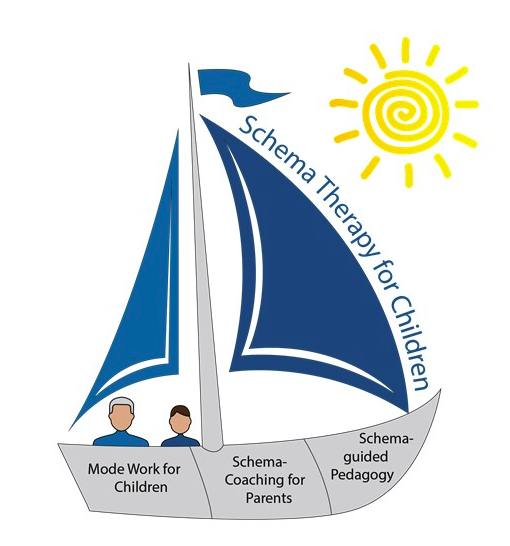
Schema Therapy, symbolized as a sailing boot |
|
For visual impressions see here: Download |
|
In deutsch hier |